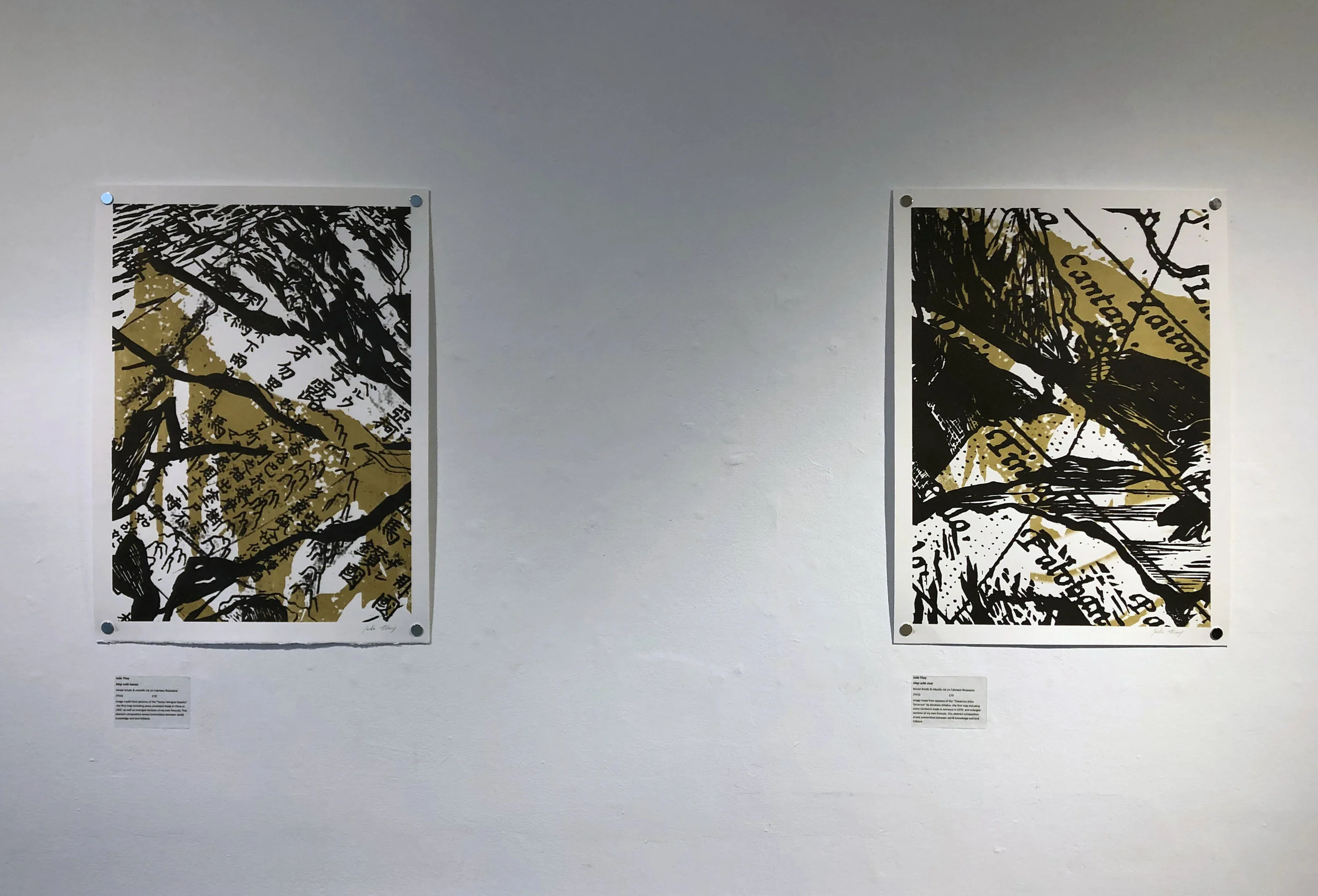
I was recently invited to show my first solo exhibition at South Hill Park Art Centre.
I wanted to explore folk lore, after being brought up with tales both from England and China my interest was in the connections between cultures. I tried to draw out the commonalities and find the inheriant human knowledge that has infused all traditional cultures. Like the syntax of language, there seems to be an unconsciously shared structure to these old belief’s that was told in folk tales and songs that still resonate in the imagination to this day although their origin and reasons be lost.
My work for this exhibition delves into the mythology surrounding birds. Birds seem to have had a special significance in folklore; sparking many mythologies, superstitions and symbolism over the course of our cultural history and in multiple countries across the world.
Quite a few different cultures, such as the Finno-Urgric people, Ainu people of Japan and Native Americans, believe that at creation the Earth was a flat boggy marsh land in which various birds like the Goose, Wagtail or Duck helped by diving or trampling the mud to create piles or valleys and thus creating the land as we know it.
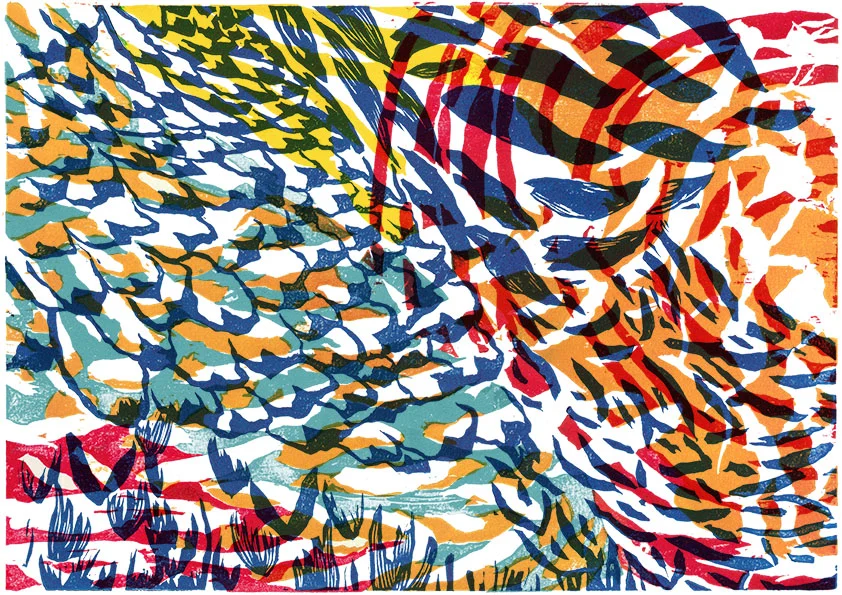
Corresponding piece to Muddiver ii
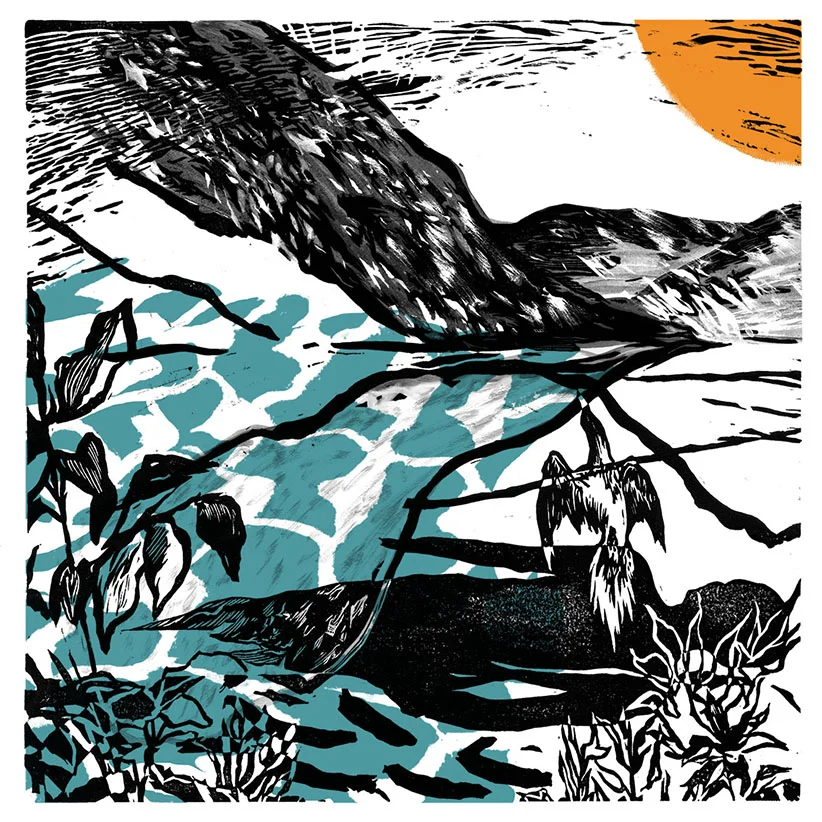
These two images are the focal point of my solo exhibition - bird’s wing. During my research into bird folklore I realised there were two roles underpinning the tales that were most common throughout the world, exploration of the spiritual and coming to understand the world around us.
That is why I have chosen to depict the folklore originating in both China and Ireland of migrating birds becoming crustaceans during their ‘hibernation’. People originally said this was as part of their lifecycles to explain why they disappeared for the winter. And also the soul transforming into a bird or being guided by a bird to transcend into the spiritual plane, a belief held in China, a verity of Arctic communities & the Aborigine culture, amongst others .
Originally meant as a diptych, these two pieces flow on from each other and are meant to reflect and compliment the other side by side, whilst also being stand alone images encapsulating what I believe was the function of folk tales in our older societies.
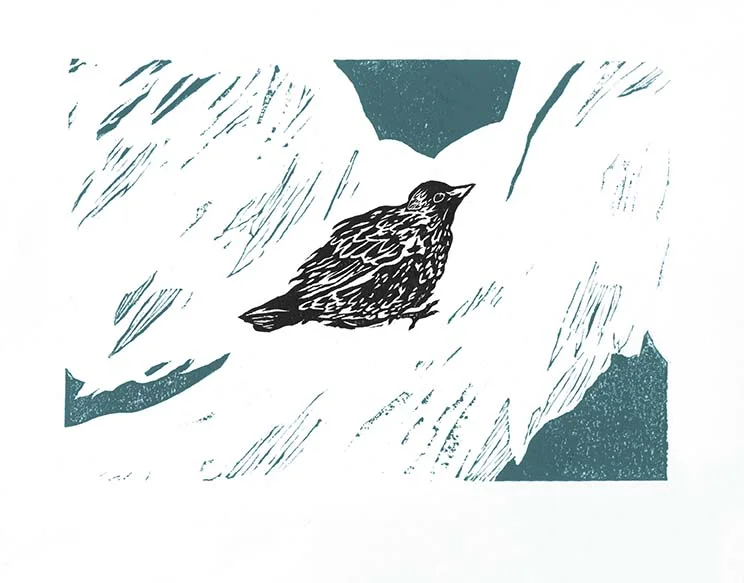
Many tales tell of how certain birds get their distinctive colours, a lot of these tales tell that originally these birds, be it the gold finch, the diver or others were originally very drab grey birds but the did something very courageous or clever in which they were rewarded or painted by another animal, god or man.
There are also tales of the birds flying so high they take on the colour of the sky or get burnt by the sun or even from blood spilled on them from Christ’s wounds as they tried to take out the thorns or nails at his crucifixion.
Various tales are woven round the majestic image of the swan, some surround beautiful women transforming into swans to escape their husbands and return to their wild nature, some tell of the rarely heard song of the swan before it dies alone on the open water.
The phoenix is a myth that many real life coloured birds claim the name, their symbolism is one that means different things to many different cultures but that is most loved in nearly all.
In many old tales ill-fated lovers were often transformed into birds so they could be together. The willow pattern (popularised in the west by Thomas Minton) was made to depict the Chinese tale of two lovers condemned to death for their love by the girl’s father, but at the last moment turned into doves by the gods. This image has become a well-known and enduring symbol of love conquering all.
Here is an image based on the Egyptian myth that small birds that migrated across large distances weren’t in fact flying but riding on larger birds to get to their destinations, the larger birds carried them because they would chatter and sing to keep them company on the long journey. There are many varied stories of birds hiding on a larger birds back to beat them in a race or to explain how such small birds can travel such long distances during migration.
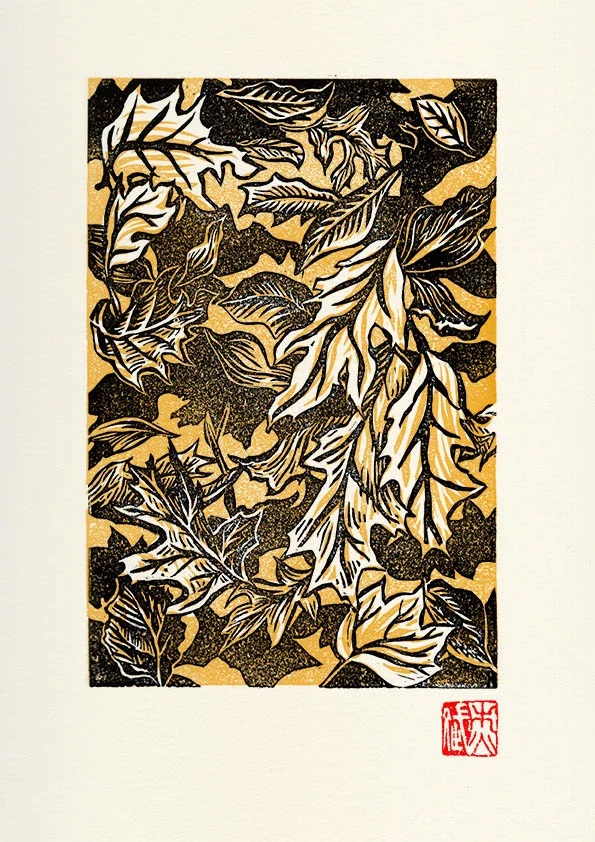
l(a
le
af
fa
ll
s)
one
l
iness
- E. E. Cummings
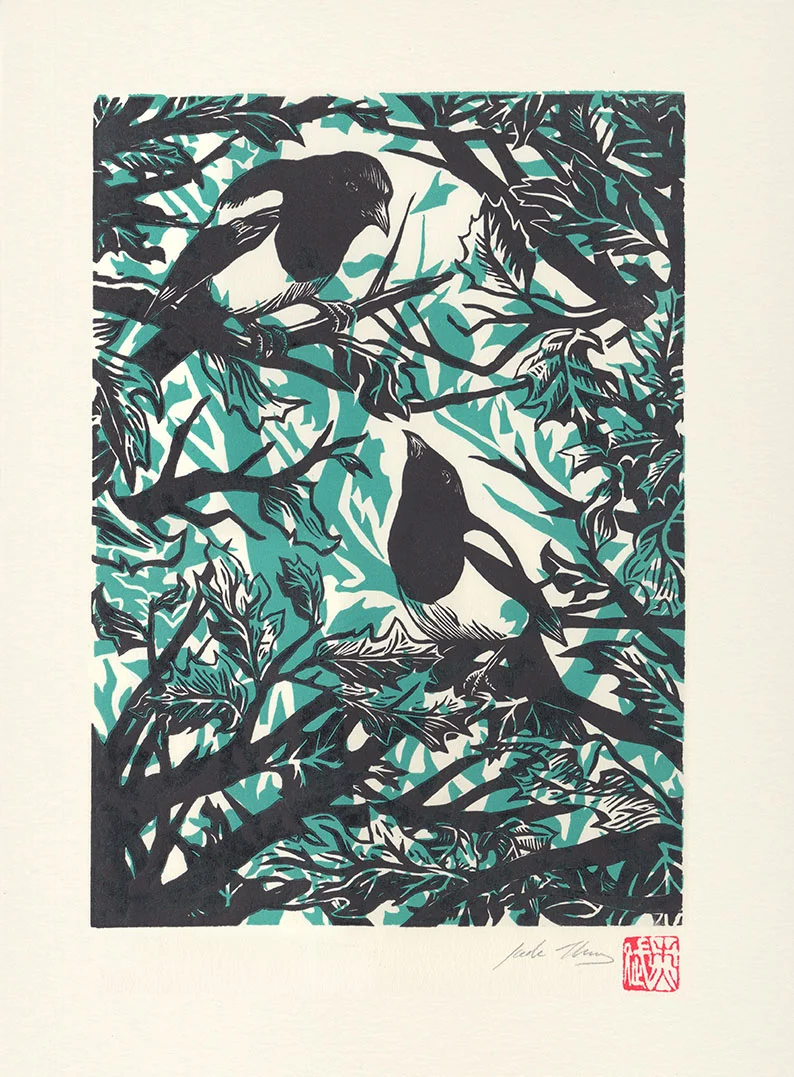
Linocut inspired by the birth of my second nephew. This piece is based on the old English rhyme 'one for sorrow, two for joy', magpies are also held as a sign of good fortune in traditional Chinese folklore and are often called the 'happiness bird’.
On a snowy evening
'Whose woods these are I think I know.
His house is in the village, though;
He will not see me stopping here
To watch his woods fill up with snow.
My little horse must think it queer
To stop without a farmhouse near
Between the woods and frozen lake
The darkest evening of the year.
He gives his harness bells a shake
To ask if there is some mistake.
The only other sound's the sweep
Of easy wind and downy flake.
The woods are lovely, dark and deep,
But I have promises to keep,
And miles to go before I sleep,
And miles to go before I sleep.'
- Robert Frost
Linocut based on the flowers growing in the Hawkswood National Trust land in September.
Linocut and woodcut print of a swallow soaring over mountains
Winter in the New Forest in Hampshire.
A linocut of the Horniman museum in Forest Hill, South London. The museum founded in the 19th Century, holds beautiful grounds as well as a interesting collection unusual anthropological objects and musical instruments from around the world.